Electrical systems today operate in a far more sensitive and interconnected environment than they did a decade ago. Automation, PLC-driven processes, variable frequency drives, and digital monitoring systems have increased operational efficiency but also heightened vulnerability.
In such systems, electrical surges are not rare anomalies. They are recurring events triggered by switching operations, grid fluctuations, or lightning activity. What often goes unnoticed is that damage from these surges is not always immediate. It accumulates quietly, weakening insulation, degrading components, and shortening equipment life.
This is where earthing arrester solutions begin to reveal their actual role. Not as passive safety additions, but as active components in electrical system stability. In industrial environments, especially, they serve as a controlled pathway redirecting excess energy away from sensitive infrastructure.
Across manufacturing hubs like Faridabad and other industrial corridors, the conversation is gradually shifting. Procurement teams are beginning to view earthing and surge protection not as compliance-driven installations, but as part of reliability engineering.
What Are Earthing Arrester Solutions?
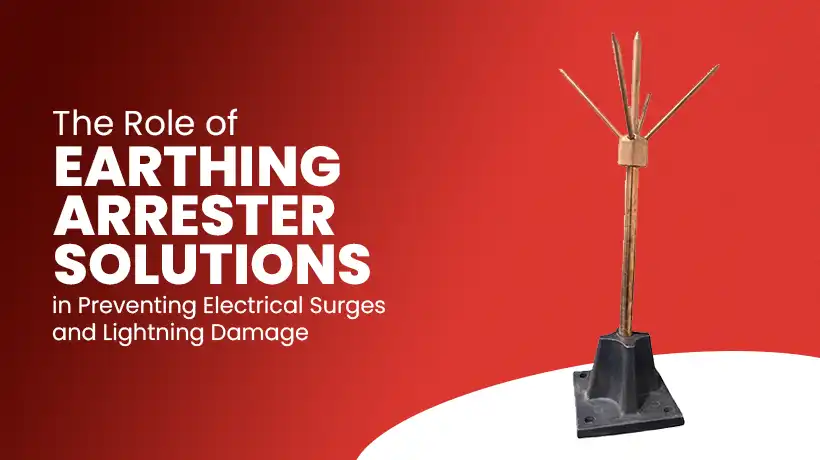
Earthing arrester solutions are integrated systems that safely channel fault currents and transient electrical surges such as lightning strikes into the ground, protecting electrical equipment, infrastructure, and personnel from damage.
They combine grounding electrodes, conductive paths, and surge arresters into a unified protection system.
A System-Level Perspective
Rather than treating earthing and surge protection separately, these solutions operate on coordinated principles:
- Provide a low-resistance path to ground
- Limit voltage spikes through arresters
- Maintain equipotential bonding across systems
This coordination is what prevents surge energy from dispersing unpredictably across equipment.
Understanding Electrical Surges & Lightning Effects
Electrical surges are sudden increases in voltage that can originate from internal switching operations or external events like lightning strikes, often lasting microseconds but capable of causing significant damage to electrical systems.
Where Surges Typically Come From
- Lightning strikes (direct or indirect)
- Switching operations in heavy machinery
- Grid disturbances or load changes
- Capacitor bank operations
The Hidden Nature of Damage
One of the more persistent misconceptions is that if equipment does not fail instantly, it has not been affected. In reality:
- Insulation stress accumulates
- Circuit components weaken gradually
- Control systems become unreliable
This delayed impact is why surge protection must be evaluated as a long-term performance factor.
Technical Specifications & Key Features
Evaluating earthing arrester solutions requires looking beyond product labels and into system behavior under stress conditions.
Core Technical Parameters
- Earth Resistance Value
Typically designed for minimal resistance to ensure rapid energy dissipation - Impulse Current Handling
Ability to withstand high-magnitude lightning currents - Voltage Protection Level (VPL)
Determines how effectively surges are limited - Thermal Stability
Critical during repeated surge events - Continuity & Bonding Integrity
Ensures no floating potentials exist within the system
Functional Role in Surge Protection
- Diverts lightning energy into the ground
- Prevents overvoltage propagation across circuits
- Stabilizes system voltage levels
- Protects sensitive electronic components
In practice, the effectiveness of these features depends on how well the system is designed not just the quality of individual components.
Materials & Production Methodology
The performance of earthing arrester solutions is deeply tied to material science and manufacturing precision.
Materials Typically Used
- Copper-bonded electrodes
High conductivity with enhanced corrosion resistance - Galvanized iron (GI)
Economical but less durable in aggressive soil conditions - Pure copper components
Superior performance but higher cost - Conductive backfill compounds
Maintain consistent soil contact and moisture retention
Manufacturing Considerations
- Thickness and uniformity of copper bonding
- Quality of galvanization processes
- Precision in electrode dimensions
- Consistency of conductive compounds
Manufacturers such as LEESAS ENERTECH LLP often emphasize system-level engineering ensuring that materials, design, and installation guidelines work cohesively.
Performance & Durability Insights
Durability in surge protection systems is often misunderstood as a function of material lifespan alone. In reality, it is a combination of electrical, environmental, and mechanical stability.
Key Influencing Factors
- Soil resistivity and moisture variation
- Corrosion due to chemical exposure
- Frequency of surge events
- Installation depth and configuration
Field Observation
A recurring issue across industrial sites is that systems initially meet resistance benchmarks but fail to maintain them over time. The reasons are often subtle:
- Inadequate bonding between components
- Degradation of conductive backfill
- Environmental changes not accounted for in design
These failures rarely occur suddenly they develop gradually, often going unnoticed until a major fault exposes the weakness.
Applications & Use Environments
Earthing arrester solutions are essential wherever electrical reliability is critical.
Industrial Applications
- Manufacturing plants with automated systems
- Electrical substations and distribution networks
- Data centers and IT infrastructure
- Renewable energy installations
- Commercial and high-rise developments
Environmental Conditions
- High humidity and rainfall zones
- Dry, rocky terrains with high resistivity
- Coastal regions with saline soil
- Industrial zones with chemical exposure
Each environment requires a tailored approach rather than a standardized configuration.
Variants / Type Comparison
Understanding different types helps in aligning solutions with operational needs.
Type |
Strengths |
Limitations |
Best Use Case |
|
Copper-bonded earthing |
Long lifespan, corrosion resistant |
Higher initial cost |
Industrial applications |
|
GI earthing |
Cost-effective |
Lower durability in harsh conditions |
Basic installations |
|
Chemical earthing |
Stable resistance, moisture retention |
Dependent on compound quality |
High-resistivity soil |
|
Maintenance-free systems |
Minimal upkeep |
Higher upfront investment |
Critical infrastructure |
The choice often reflects a balance between lifecycle cost and operational risk tolerance.
Buyer Evaluation Checklist
When assessing earthing arrester solutions, decision-making benefits from a structured evaluation.
Technical Evaluation
- What surge current rating is supported?
- How stable is resistance across seasons?
- What materials are used and how are they treated?
- Is the system tested under impulse conditions?
Installation & Design
- Recommended electrode depth and spacing
- Type of backfill material used
- Bonding and interconnection strategy
Supplier Consideration
- Does the supplier provide system-level guidance?
- Is there clarity in manufacturing and material specifications?
A careful evaluation at this stage often reduces long-term operational uncertainty.
Frequently Asked Questions
How do earthing arrester solutions protect against lightning?
They provide a low-resistance path that safely directs lightning current into the ground, preventing it from passing through electrical equipment.
Can surge protection work without proper earthing?
No. Without effective earthing, surge protection devices cannot safely dissipate excess energy, making them significantly less effective.
What is the ideal earth resistance for surge protection?
It depends on the application, but generally low resistance (often below 1 ohm for critical systems) is preferred for effective surge dissipation.
Do earthing systems require maintenance?
Yes. Periodic testing and inspection are necessary to ensure resistance levels remain within acceptable limits.
What causes earthing systems to fail?
Common causes include corrosion, soil condition changes, improper installation, and degradation of conductive materials.
Supply & Distribution Capability
Manufacturing location plays a subtle but important role in supply responsiveness and technical support.
With its base in Faridabad, LEESAS ENERTECH LLP operates within a well-established industrial ecosystem. This positioning supports:
- Efficient access to raw materials
- Timely distribution across industrial regions
- Practical alignment with manufacturing requirements
For a broader understanding of geographic presence, refer to:
https://leesasenertech.in/our-presence
Detailed product specifications and system configurations can be explored here:
https://leesasenertech.in/leesas/earthing-arrester-solutions
Conclusion
Electrical surges and lightning events are often treated as unpredictable external risks. Yet, their impact on industrial systems is both measurable and preventable if approached with the right engineering mindset.
Earthing arrester solutions play a foundational role in this approach. Not by eliminating surges, but by managing them channeling energy safely and maintaining system stability.
A consistent observation across industrial environments is that failures rarely occur due to a single missing component. They arise from gaps in system thinking where grounding, surge protection, and material selection are treated independently.
Taking a system-level view one that considers environment, materials, and long-term performance can significantly reduce operational risks.
If you are evaluating this product for an upcoming project, reviewing specifications and application conditions carefully can help avoid procurement risks. For further technical guidance or product details, you can contact the team at LEESAS ENERTECH LLP:
https://leesasenertech.in/contact-us